Things are known by their opposites.
An old saying, found in Arabic and Persian poetry
The idea is very old. Heraclitus noticed that illness is what makes health feel good, hunger is what makes a full stomach welcome, and tiredness is what makes rest sweet. We understand light because we know darkness, and we understand up because we know down. Seeing one side of a pair tells us what the other side means.
Mathematics is full of such pairs. Subtraction undoes addition, division undoes multiplication, and a logarithm undoes an exponential. Each opposite runs the first operation backwards: if squaring a positive number gave $49$, the square root says it was $7$.
Differentiation has an opposite too
Differentiation is an operation like any other: it takes a function and returns its derivative. So it is natural to ask for the opposite. Given a function $f$, find a function $F$ whose derivative is $f$. Such an $F$ is called an antiderivative of $f$.
You already know plenty of them, because every derivative you have learnt can be read backwards.
- The derivative of $x^3$ is $3x^2$, so $x^3$ is an antiderivative of $3x^2$.
- The derivative of $\sin x$ is $\cos x$, so $\sin x$ is an antiderivative of $\cos x$.
- The derivative of $e^x$ is $e^x$, so $e^x$ is its own antiderivative.
- The derivative of $\ln x$ is $\dfrac{1}{x}$, so for $x > 0$, $\ln x$ is an antiderivative of $\dfrac{1}{x}$.
Running the power rule backwards gives a general recipe: raise the power by one and divide by the new power.
$$x^n \;\longrightarrow\; \frac{x^{n+1}}{n+1}, \qquad n \neq -1.$$
So an antiderivative of $x^2$ is $\dfrac{x^3}{3}$. To check, differentiate: the $3$ comes down and cancels the $3$ underneath.
There is one way in which this opposite is less tidy than subtraction. The derivative of a constant is zero, so $x^3 + 5$ and $x^3 - 2$ are antiderivatives of $3x^2$ as well. Antiderivatives come in families, written $F(x) + C$.
A different problem: area
Now set antiderivatives aside. Here is a question that seems to have nothing to do with them: how much area lies under a curve?
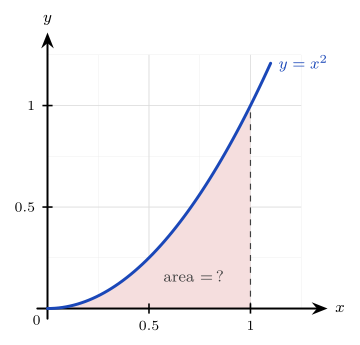
Rectangles, triangles and circles have area formulas. A region under a general curve has none. So we approximate. Cut the interval from $a$ to $b$ into thin strips of width $\Delta x$, replace each strip by a rectangle, and add up the rectangles:
$$\sum_{i=1}^{n} f(x_i)\,\Delta x.$$
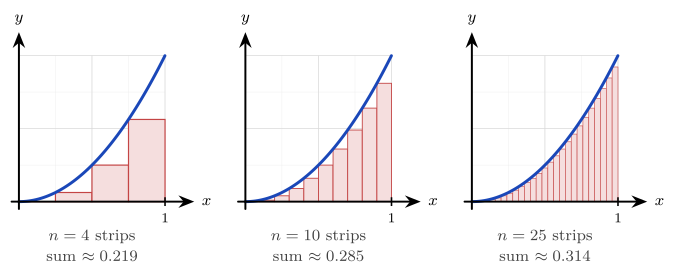
The rectangles never fit the curve exactly, but the narrower the strips, the smaller the error. Under $y = x^2$ on $[0, 1]$:
| strips, $n$ | 4 | 10 | 100 | 1000 |
|---|---|---|---|---|
| sum | $0.219$ | $0.285$ | $0.328$ | $0.3328$ |
The sums close in on $\tfrac13$. The area is the value the sums approach as the strips become infinitely thin, and that limit is the definite integral:
$$\int_a^b f(x)\,dx = \lim_{\Delta x \to 0} \sum_i f(x_i)\,\Delta x.$$
The notation says the same thing. The long S stands for sum, and $f(x)\,dx$ is one rectangle of height $f(x)$ and tiny width $dx$. An integral is an infinite sum of infinitely thin strips.
The difficulty
This definition says what the area is, but not how to find it. A computer can add a thousand rectangles. It still only gets close, because the exact answer is a limit. Every new curve would need its own limit, and that is hard work even for $x^2$.
The good news
Integration happens to be the same as antidifferentiation. To find the area, you do not add any rectangles at all. Find an antiderivative and subtract.
If $f$ is continuous on $[a, b]$ and $F$ is any antiderivative of $f$, then
$$\int_a^b f(x)\,dx = \Bigl[F(x)\Bigr]_a^b = F(b) - F(a).$$
This is the Fundamental Theorem of Calculus. Try it on the area the table was closing in on. An antiderivative of $x^2$ is $\tfrac{x^3}{3}$, so
$$\int_0^1 x^2\,dx = \frac{1^3}{3} - \frac{0^3}{3} = \frac13.$$
A thousand rectangles only came close to that value. The theorem gives it exactly, in one line. Here is one more. The area under one arch of $y = \sin x$, from $0$ to $\pi$, uses the antiderivative $-\cos x$:
$$\int_0^\pi \sin x\,dx = (-\cos \pi) - (-\cos 0) = 1 + 1 = 2.$$
A curved region bounded by a wave has an area of exactly $2$. Notice also that the $+C$ never matters here: whichever antiderivative you choose, the constant cancels when you subtract.
Why should this be true?
Nothing so far explains why reversing a derivative should measure an area. One is a question about slopes, the other about adding up strips. That they agree is a theorem, and it takes a proof. The proof is short and uses only the definition of the derivative and a picture of one thin strip. Why area and slope are the same calculation walks through it.
For now, take the result and use it. From here on, finding an area under a curve means finding an antiderivative, and every antiderivative you learn is a new area you can calculate. The derivative is known by its opposite after all.
Chapter 15 of BetterMath, Integral Calculus, builds the same story in §15.1: antiderivatives first, then area as a limit of sums, then the theorem that joins them. The full proof comes at the end of the chapter, just after the Reflections.