Calculus asks two questions that seem to have nothing to do with each other. The first runs a derivative backwards: given $f$, find a function $F$ with $F' = f$. The second is about area: how much space lies under a curve? The Fundamental Theorem of Calculus says that these are the same question, and it is worth seeing why rather than taking it on trust.
Area as a limit
A region under a general curve has no area formula, so we approximate it. Cut the interval into $n$ strips of width $\Delta x$ and replace each strip by a rectangle:
$$\sum_{i=1}^{n} f(x_i)\,\Delta x.$$
Under $y = x^2$ on $[0, 1]$, rectangles that take their height from the left end of each strip all sit below the curve, and rectangles that take it from the right end all rise above it. The true area is trapped between the two sums:
| strips, $n$ | 4 | 10 | 100 | 1000 |
|---|---|---|---|---|
| low estimate | $0.219$ | $0.285$ | $0.328$ | $0.3328$ |
| high estimate | $0.469$ | $0.385$ | $0.338$ | $0.3338$ |
The two rows close in on $\tfrac13$. That limit is the definite integral, $\int_0^1 x^2\,dx$. The definition is clear, but it gives no practical way to calculate anything: nobody wants to add a thousand rectangles by hand.
The theorem
If $f$ is continuous on $[a, b]$ and $F$ is any antiderivative of $f$, then
$$\int_a^b f(x)\,dx = F(b) - F(a).$$
An antiderivative of $x^2$ is $\tfrac{x^3}{3}$, so
$$\int_0^1 x^2\,dx = \frac{1^3}{3} - \frac{0^3}{3} = \frac13,$$
the value the thousand rectangles were approaching, found in one line. Any $+C$ in $F$ cancels in the subtraction, which is why a definite integral is a plain number.
Why it is true
Take $f(x) \ge 0$ and define the area function $A(x)$ as the area under the curve from $a$ up to a moving right end $x$. Move that end a little, from $x$ to $x + h$. The extra area $A(x+h) - A(x)$ is one thin strip.
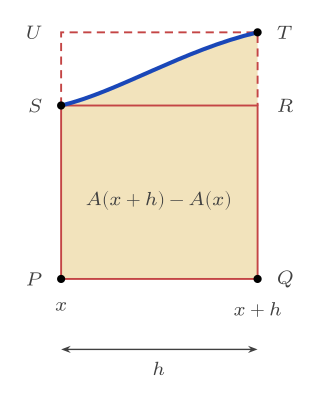
The strip contains the rectangle $PQRS$, of height $f(x)$, and fits inside the dashed rectangle $PQTU$, of height $f(x+h)$. Both have width $h$, so
$$f(x)\,h \;\le\; A(x+h) - A(x) \;\le\; f(x+h)\,h,$$
and dividing by $h$,
$$f(x) \;\le\; \frac{A(x+h) - A(x)}{h} \;\le\; f(x+h).$$
As $h \to 0$, $f(x+h) \to f(x)$ because $f$ is continuous. The middle term is the definition of $A'(x)$, and it is squeezed between them:
$$A'(x) = f(x).$$
So the area function is an antiderivative of $f$. Any other antiderivative $F$ differs from it by a constant: $A = F + C$. The area from $a$ to $a$ is zero, so $C = -F(a)$, and at $x = b$ we get $A(b) = F(b) - F(a)$. That is the theorem. If the curve falls across the strip, the two rectangles swap roles and the squeeze still works.
Reading it the other way
Write the integrand as a derivative, $f = F'$:
$$\int_a^b F'(x)\,dx = F(b) - F(a).$$
Adding up a rate of change across an interval gives the total change over that interval. The area under a velocity graph is a displacement, and the area under a flow-rate graph is a volume. One idea connects slopes and areas, and it is the reason integration works at all.
Chapter 15 of BetterMath, Integral Calculus, states the theorem in §15.2, uses it throughout, and gives the full proof at the end of the chapter, including the case where $f$ takes negative values.